The design question.
Examine the gap between packaging designed for controlled settings and the practical demands of prehospital care, then identify considerations that could inform future design.
2024 exploratory study · 2026 presentation
Practitioner accounts informed four priorities for medical packaging. These are research findings to investigate through future design and testing.
Materials and opening mechanisms affect how easily supplies can be reached and handled.
Readable labels, prominent dates and clear product identification help people find what they need.
Differences in colour and layout between similar products can create confusion during selection.
Pressure, available space and equipment organisation influence how packaging is found and handled.
Three interview sessions, including a pilot and a paired interview. Small qualitative study; no redesigned product or clinical outcomes were tested.
Open the full diagram (opens in a new tab)11 pages · PDF · 7.9 MB · Selected academic pages
Examine the gap between packaging designed for controlled settings and the practical demands of prehospital care, then identify considerations that could inform future design.
Independent literature review, research framing, interview design and refinement, interviewing, transcription, thematic analysis and research communication.
Individual BA Honours in Design Leadership research at IIE Vega, completed November 2024. A small qualitative study of practitioner experiences; it did not test a redesigned product or measure clinical outcomes.
The literature review considered human factors, communication and the realities of prehospital work. The project asked where packaging makes identification and access harder, and how designers could better understand those needs.
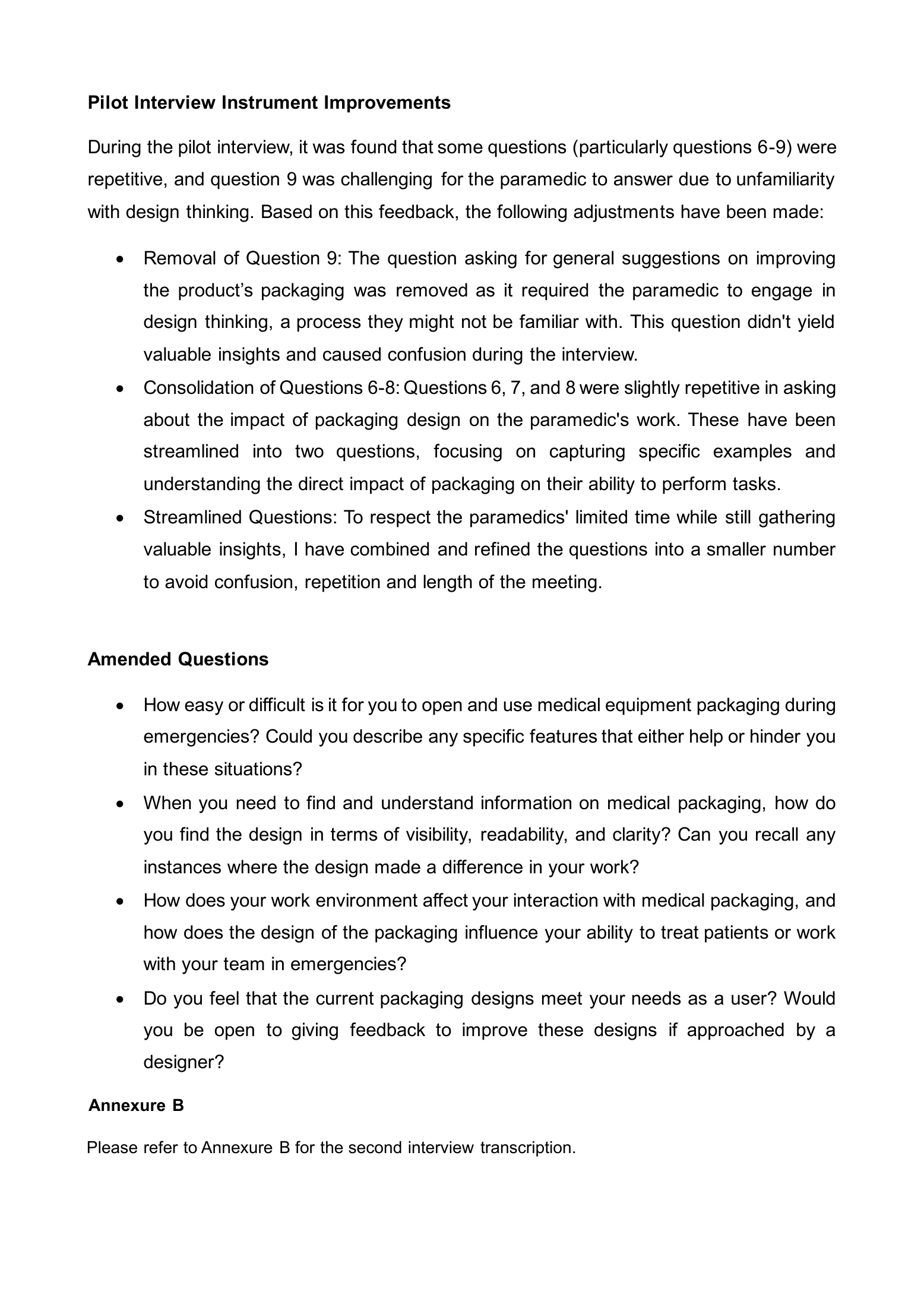
An initial interview guide was piloted, revealing repetition and a question that asked participants to solve the design problem themselves. The guide was shortened and refocused on concrete experiences, visibility, handling and feedback.
Three interview sessions, including a pilot and a paired interview, explored practitioners’ experience of packaging. The collection method adapted to availability and connectivity, combining digital conversations, voice notes and an in person session.
Thematic analysis identified ease of opening, visible product information, consistent visual cues and the effect of pressure and equipment organisation. These became priorities for future packaging work and for involving end users in evaluation.
The report and poster bring the research into a design conversation. Recommendations remain exploratory: broader sampling and practical testing would be needed before claiming that a change improves safety, speed or patient outcomes.
 View artwork
A completed research report, refined interview guide, thematic findings and communication poster. The work provides a reasoned foundation for future packaging briefs and user evaluation.
Continue exploring
All design research Selected Work Discuss a project